
Decide every payout with the full evidence in view.
Unauth brings order, delivery, support, and financial context into one merchant-controlled case, applies your rules, and keeps loss ownership and recovery work in the same auditable timeline.
Recommendations stay explainable. Final customer and recovery actions stay with your team.
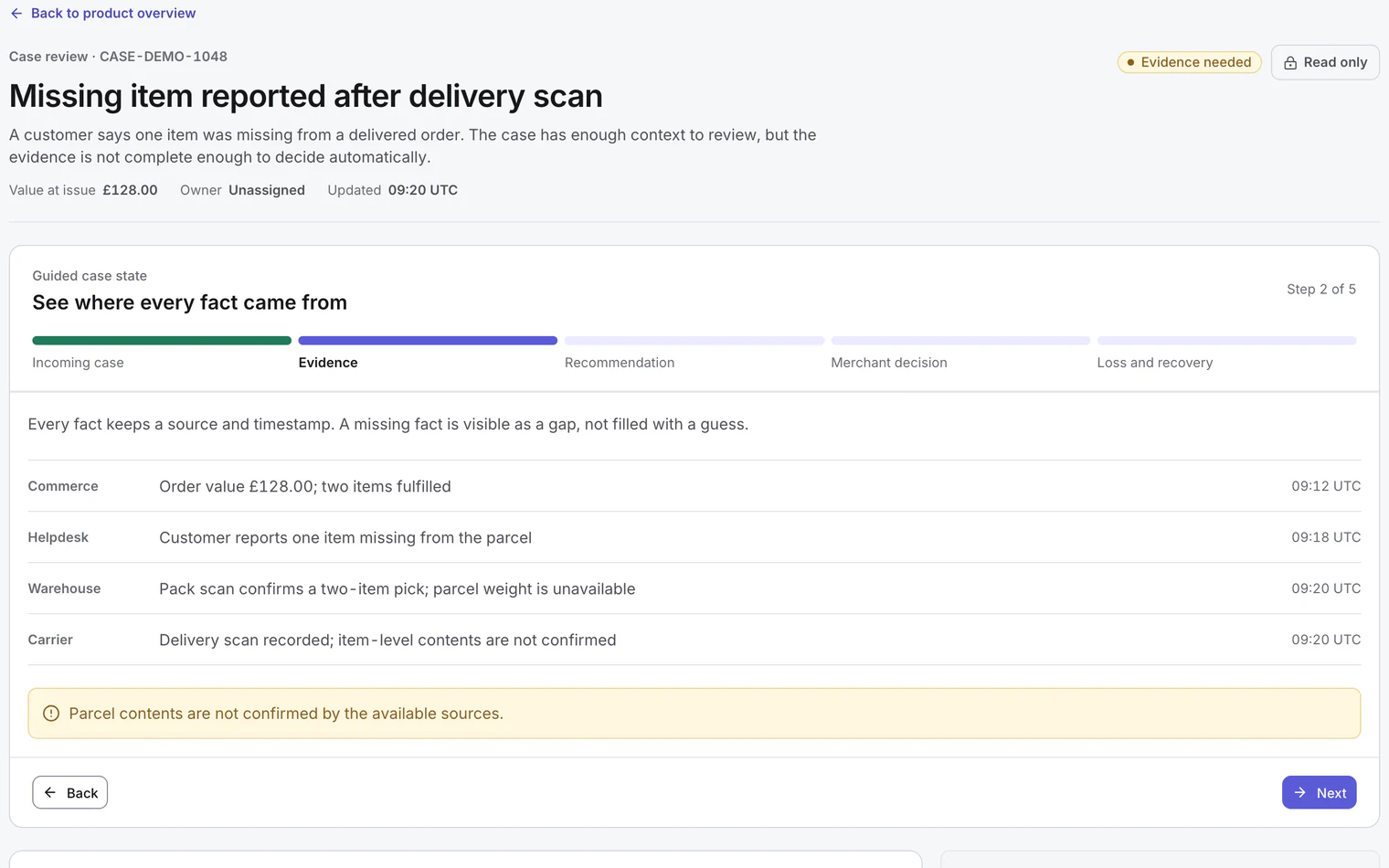
Evidence, recommendation, and recovery context stay in one case.
These images are captured from the shipping public demo route with the same product tokens, status grammar, and working-surface primitives used in the authenticated product.
Open the interactive case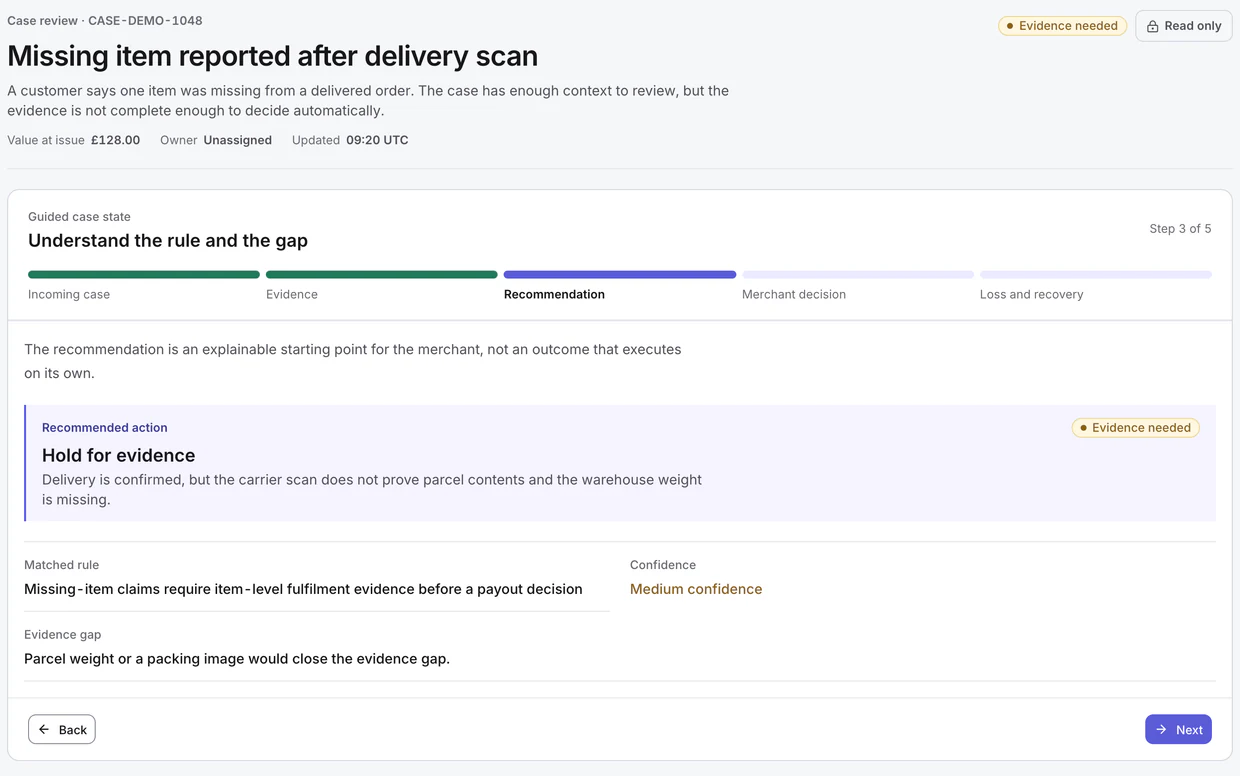
One evidence spine from source fact to merchant outcome.
Keep source facts distinct
Commerce, support, fulfilment, and carrier records retain their source and timestamp.Explain the recommendation
The matched rule, evidence gap, and confidence remain visible before the team decides.Record the merchant outcome
The merchant-owned decision and any recovery handoff stay on the same auditable timeline.
Provider records feed one case model.
Commerce, support, fulfilment, payment, and imported records retain their provenance. No provider creates a separate case lifecycle.
- Shopify
- BigCommerce
- WooCommerce
- Gorgias
- Zendesk
- Freshdesk
- ShipBob
Common questions
- For every case it shows who may own the loss — carrier, warehouse, customer, or a policy override. Where a loss may be recoverable, it assembles the evidence with the deadline attached. Lost-in-transit parcels may be the carrier's liability; wrong-item shipments may be the 3PL's. Unauth prepares the case so your team can decide whether to submit it.
- Because you cannot recover a loss you have already refunded and forgotten. The carrier's claim window closes. Evidence goes stale. Keeping the case visible while your team is deciding protects the recovery option without taking the decision away from you.
- No. Unauth only uses a customer's case history with you — cases they have opened on your own store. There is no shared database, no cross-merchant profile, no external score. The pattern you see is built from your own data and it stays yours. The difference is that Unauth surfaces it at the one moment it matters, before your team or your AI acts on it.
- They close tickets fast. Unauth adds evidence, recommendations, and recovery context before your team records the outcome. They work together while the merchant keeps the final decision.
- Low-risk cases — first-time customer, no unusual signals, clean delivery — pass straight through at full speed. Only cases that match your configured rules are held. You control the thresholds. Genuine customers with genuine problems are not affected.
- You do, through your rules. Unauth surfaces the facts — delivery state, order value, how many cases this customer has opened with you, whether the evidence is consistent — and applies the thresholds you configure. The decision reflects your policy, not our guess about a customer.
KEEP THE EVIDENCE BESIDE THE DECISION.
Recommendations
Unauth applies merchant-owned rules and explains the evidence behind each recommendation.
Decisions
Your team makes and records the final customer, payout, responsibility, and recovery decision.
Recovery
Possible recovery routes remain visible with their evidence requirements and deadlines.
Connect your store and helpdesk. Unauth puts every case in front of your team with the evidence, loss ownership, and recovery next step while the window is still open.
Create workspace